Self-directed case study · No real users yet, and this doc says so honestly
01
THE SPARK
Picked up freelance work on gig platforms
Finding clients: easy. Managing money that shows up in random chunks: not
Went looking for an app. Found something more uncomfortable than the money problem itself:
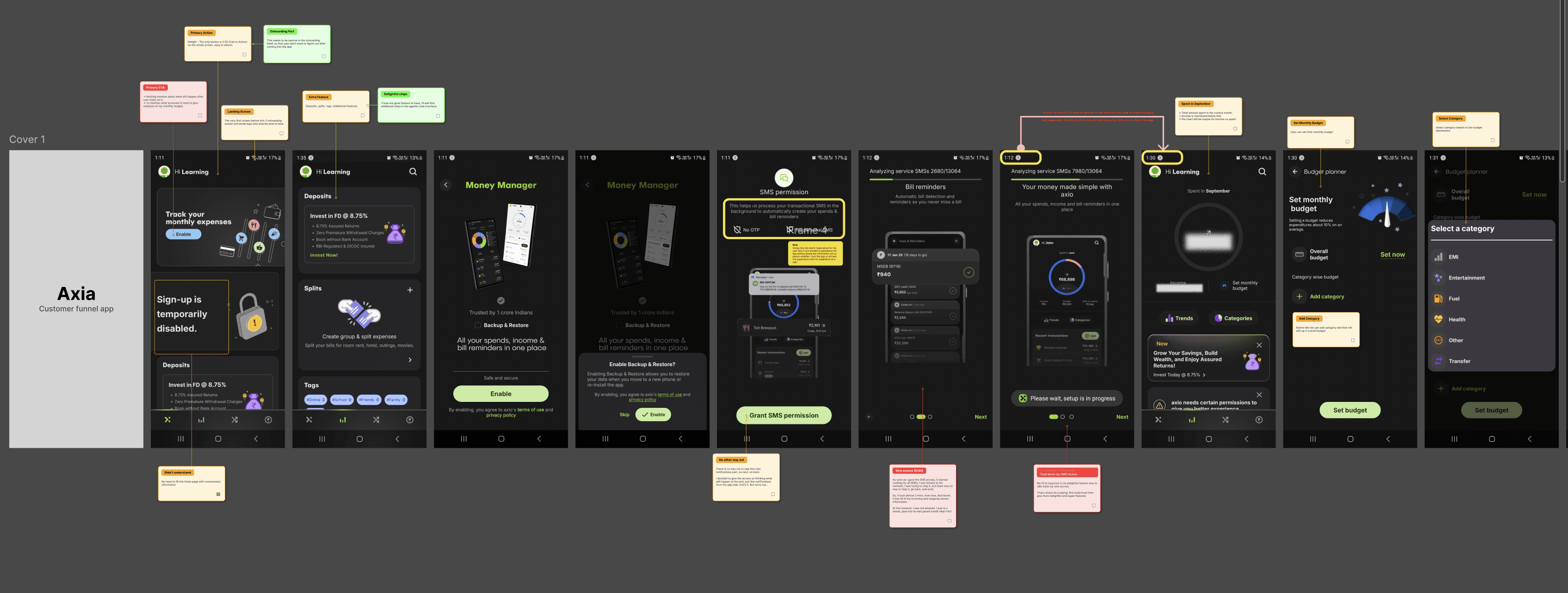
Opened a money app, gave SMS access
2–3 minutes later: entire financial history reconstructed, from reading text messages
Turns out — it's the brand behind an RBI-registered lending company (BNPL, personal loans, FDs)
The "budgeting" feature isn't the product. It's the funnel.
The design principle this set for everything after:
The agent's only job is to help the user. Zero hidden monetization pulling the other way.
02
WHY
Why this problem is bigger than it looks?
India's gig/freelance workforce: 7.7M → 12M in 4 years (+55%)
Now 2%+ of the entire workforce
Economic Survey: income volatility directly makes credit access harder for this group
Not a budgeting inconvenience — a financial-exclusion problem in disguise
03
WHAT I DID
Why this problem is bigger than it looks?
General Questions
Ques. 1) Who's affected, how many?
Ans. Gig/freelance workers, 7.7M→12M in 4 yrs (+55%), 2%+ of workforce
Ques. 2) What are they doing instead?
Ans. Spreadsheets, mental math, or apps like Axio — a lending funnel dressed as budgeting
Ques. 3) Why do existing tools fail them?
Ans. Flatten irregular income into a fake average, losing the one signal that matters: confidence
Ques. 4) Cost of staying unsolved?
Ans. Economic Survey ties this volatility directly to harder credit access
Ques. 5) Design problem, data problem, or both?
Ans. Both, forecasting logic and how uncertainty gets communicated
Ques. 6) Smallest version that's still genuinely useful?
Ans. Cold start + low confidence + established baseline, manual input only, before edge cases
Specific Questions
Ques. 1) What does "safe to spend" mean with no fixed paycheck?
Ans. see Math section
Ques. 2) How much history = trustworthy forecast?
Ans. Confidence tiers, see Math section
Ques. 3) Warn, restrict, or inform - who decides?
Ans. Inform, not restrict - hard lock was considered and rejected, see below
Ques. 4) What happens when the user disagrees?
Ans. Logged, shapes future forecasts - see Math section, override handling
THE THESIS
If the system shows how confident it is, not just one flat number; people trust and act on it more than a static budget line.
04
THE MATH
Safe-to-spend = Trailing avg. income − Fixed expenses − Reserved buffer %
Confidence tiers
0–1 mo → wide range, heavily buffered, labeled low confidence
2–3 mo → narrowing range
4+ mo consistent → tight range, high confidence
Outlier handling — payment >2x average → partially weighted in over next few cycles, not dumped straight into the baseline
Override handling — logged, shapes future forecasts, not silently ignored
05
WALKTHROUGH
Onboarding
No SMS permissions
3 steps, everything typed by hand, on purpose
Conversational Dashboard
Bank balance & income, blurred by default
"Spent so far" / "Safe to save" → visible, the actual point of the product
Quick-question chips
Adding income = a small trust ritual
Before saving: "Finy will receive: 'I received ₹10,000 on 10 September 2026.'"
User sees exactly what the agent gets, in plain words, every time.
06
WHAT I REJECTED
IDEA
Hard Spending Lock
SMS-based auto-import
WHY IT DIED?
Paternalistic treats users as untrustworthy with their own money
The fast path. Ruled out on principle after the Axio discovery, opacity is the exact thing this project argues against
07
HONEST STATUS
Self-directed build, not launched
No real users tested yet — not dressing that up with a fake number
If I tested next: 5–8 real gig workers, watch whether they act on the number during cold-start/low-confidence states, or ignore it like every other app. Override frequency = the real trust signal.
08
WHAT'S NEXT
Validate the confidence-tier framing with real users
Explore RBI Account Aggregator flow as a consent-based import option, without losing the transparency principle
Handle multiple competing High-priority goals, not just one at a time